Biscuits from Scratch: Tall, Flaky American-Style Recipe
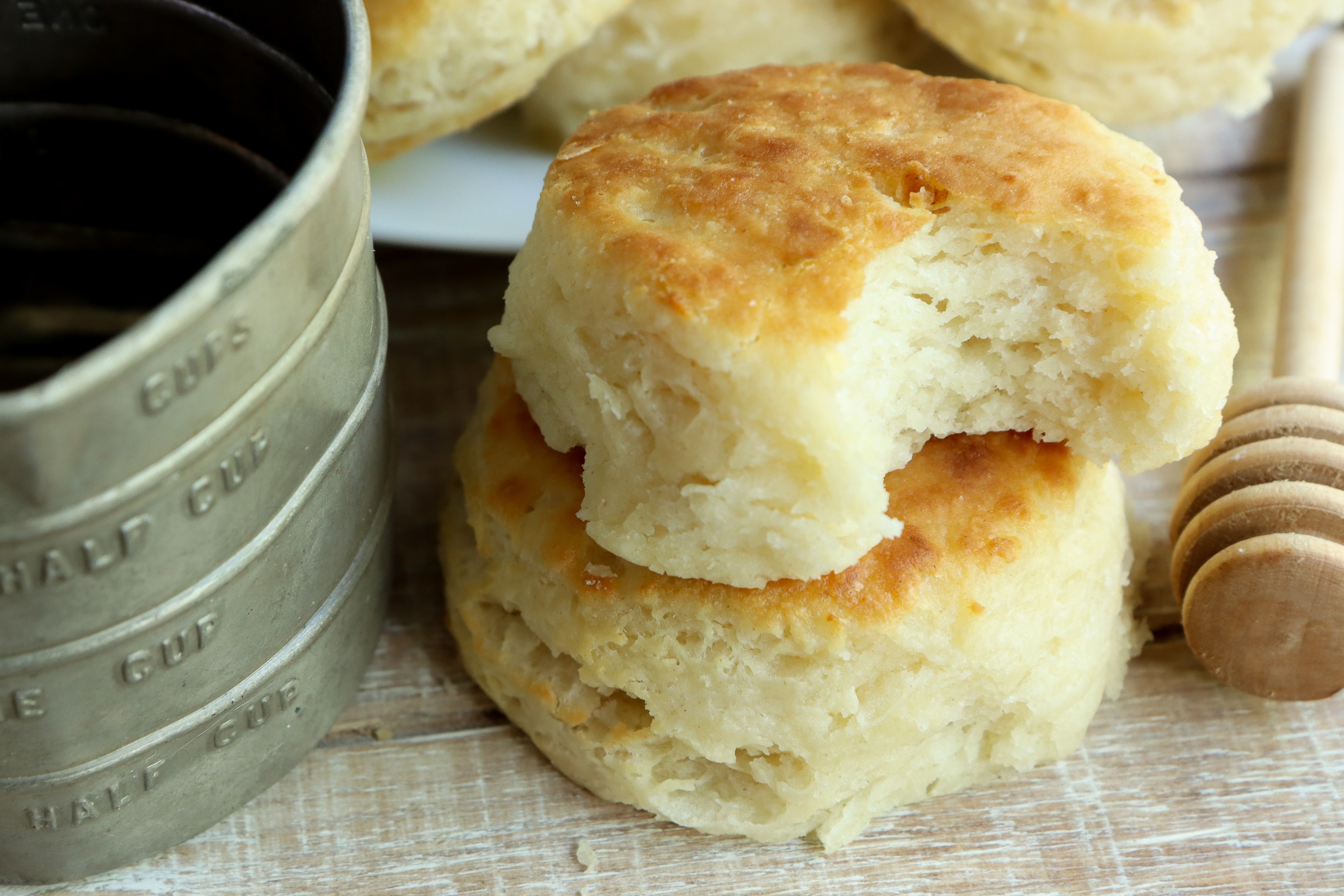
Soft, flaky biscuits come down to three things: very cold butter, minimal mixing and a hot oven. This recipe is in grams, millilitres and °C, and walks through each step.
A quick note on terms. "Biscuits" here means the American kind: tender, layered, scone-like rolls served with butter, jam or gravy. In the UK the word means cookies, which is a different bake and not covered here.
What "Biscuits" Means Here and the Recipe in Grams
Yield: about 10 biscuits, cut with a 7.5 cm round cutter.
Timing: One source recipe (Chopping Block) lists 5 minutes of prep and 15 minutes of baking, 20 minutes in total. That is a simpler method than the folded one below. Allow a little extra for folding and cutting. Bake time at 220°C has not been verified by us, so judge doneness by colour (see below).
Ingredients
- 260 g all-purpose (plain) flour
- 22 mL (1½ tablespoons) baking powder, preferably aluminium-free
- 5 mL (1 teaspoon) sugar
- 4 mL (¾ teaspoon) salt
- 113 g cold unsalted butter, cut into 1.5 cm cubes and chilled again
- 210 mL cold half-and-half (10% cream), or the cream and milk mix described in the substitutions section
- about 7 g melted butter, for brushing
These quantities are a metric conversion of a published US recipe (Natasha's Kitchen), which uses 2 cups flour, 1½ tablespoons baking powder, 1 teaspoon sugar, ¾ teaspoon salt, ½ cup butter and 1 cup of half-and-half minus 2 tablespoons. The flour weight uses 130 g per cup, the same ratio as the self-rising flour figure in the Inspired Taste and Boston Girl Bakes recipes (1½ cups = 195 g). Weigh the flour if you can. A test cited by Mashed (from The Spruce Eats) found that scooping flour carelessly can add up to 20% more flour, which makes biscuits dry and heavy.
As a rough sanity check, Bakeschool describes biscuits and scones as about 1 part fat to 2 parts liquid to 3 parts flour by weight. This recipe has more flour than that, so treat the ratio as a guide rather than a rule.
Step-by-Step Method: Cold Butter, Gentle Mixing, Folding, Cutting and Close Spacing
- Chill everything. Keep the butter and the cream very cold until the moment you use them. Put the cubed butter in the freezer for 10 to 15 minutes while you measure the rest. Cold butter and cold liquid are the most consistent tip across the sources.
- Heat the oven. Preheat to 220°C and place a baking sheet or an oven-safe skillet inside or alongside. See the oven notes below for why this temperature.
- Mix the dry ingredients. Whisk the flour, baking powder, sugar and salt in a large bowl.
- Work in the butter. Add the cold cubes and quickly press and rub them into the flour with your fingertips or a pastry cutter. Stop while visible pieces of butter remain. Those pieces create the flaky layers.
- Add the cream. Pour in the cold liquid and stir with a fork or spatula just until the dough comes together. It will look shaggy, and that's fine. Overworking is named as a main reason biscuits fail to rise, and Food52 (cited by Mashed) notes that undermixing can hurt as well.
- Fold for layers. Tip the dough onto a lightly floured surface. Pat it into a rough square and fold it in thirds like a letter. Turn it 90° and fold in thirds again. This gives 9 layers (3 × 3), the method described by J. Kenji López-Alt in the Serious Eats Food Lab. He notes that repeating the process multiplies the layers further, up to 81, but he is "not quite so ambitious" with his own dough. One round of folding is plenty here.
- Pat out and cut. Pat the dough to a thickness of about 2 cm. Dip the cutter in flour, press it straight down and lift it straight up. Do not twist. Gather the scraps gently, pat them out once, and cut again.
- Place close together. Put the biscuits on the hot sheet or in the skillet with their sides touching. Inspired Taste recommends this because it helps them rise higher.
- Brush and bake. Brush the tops with the melted butter. Bake at 220°C until the tops are deep golden. Start checking around the 15-minute mark and give them a few more minutes if they are pale. Keep the oven door closed until then.
How to tell they're done: tall, golden-brown tops, with browning on the bottoms as well. If the sides touching each other still look doughy, bake a few minutes longer.
Common Mistakes That Make Biscuits Flat or Dense (and How to Fix Them)
Boston Girl Bakes has a useful list of reasons biscuits come out flat. Here are those mistakes with fixes:
- Old baking powder or baking soda. Check the date on the packet. This is an easy fix, and it matters a lot in a recipe that relies on chemical leavening.
- Skipping the folding. The folds build layers. Without them you get a more uniform, cake-like crumb.
- Twisting the cutter. Press straight down and lift straight up (Inspired Taste).
- Placing biscuits too far apart. Let them touch so they support each other as they rise.
- Baking at too low a temperature. Mashed, citing Southern Kitchen, says that 350°F (about 175°C) gives floppy, flat biscuits.
- Opening the oven door. Wait until they are well risen and coloured.
- Warm butter or overmixed dough. If the butter softens and blends into the flour, chill the dough for 10 minutes before cutting. Stir only until it just holds together.
For a wider look at the problem, see our guide to why baked goods turn out flat (recommended page: Why Baked Goods Turn Out Flat) on the recipe site. You can also read Boston Girl Bakes' full article on flat biscuits.
Substitutions, Oven Temperature Notes and Food Safety
Self-rising flour
Self-rising flour already contains baking powder and salt. If you use it, leave those two ingredients out of the recipe. The sources do not give exact quantities for this recipe, so make a first batch carefully and note how it rises.
Cream and milk instead of half-and-half
Bakeschool suggests mixing cream and milk to make a 10% half-and-half: for 250 mL, 80 mL of 35% cream plus 170 mL of milk. Scaled down to the 210 mL this recipe needs, that is roughly 65 mL of 35% cream plus 145 mL of milk. Chill the mix well before using it.
Buttermilk
Many classic recipes use buttermilk. The Serious Eats Food Lab buttermilk biscuits are a good example, and that recipe also uses baking soda. Don't swap buttermilk into this one one-for-one without adjusting the leavening, because the two recipes are balanced differently. A guide to buttermilk substitutes would be a useful companion on our recipe site (recommended page: Buttermilk Substitutes).
Oven temperature
The sources disagree. Serious Eats preheats to 425°F (220°C), Chopping Block uses 450°F (about 232°C), and Mashed says 425°F is the minimum. This recipe uses 220°C as the best-supported default. If your biscuits brown too fast on the bottom, lower the rack or move the baking sheet up a level. Home ovens are often inaccurate, with Bon Appétit (cited by Mashed) reporting errors as large as 75 degrees, so an oven thermometer is worth having.
Food safety and storage
This recipe contains no eggs, but it does contain butter and cream, so keep both refrigerated until you use them and don't leave the dough sitting at room temperature. Biscuits are best eaten fresh from the oven. We could not find a reliable source for how long baked biscuits keep, so we won't give a shelf life. For freezing, Mashed suggests that unbaked biscuits can go into the oven without thawing, with 5 to 10 extra minutes of baking. That source was only partly visible, so test it with a small batch first.
For the technique behind the layers, see the Serious Eats Food Lab. For the ratio and the cream substitute, see Bakeschool's guide.
FAQ
Why didn't my biscuits rise?
The usual causes are old baking powder, butter that warmed up, overmixed dough, a twisted cutter, biscuits spaced too far apart or an oven that wasn't hot enough. Check the leavening date first, then check your oven with a thermometer.
Can I use self-rising flour or a cream and milk mix instead of half-and-half?
Yes to both. With self-rising flour, omit the baking powder and salt. For the liquid, mix about 65 mL of 35% cream with about 145 mL of milk to replace 210 mL of 10% half-and-half.
Do I need to fold the dough?
Folding is optional but recommended. It builds the layers that make biscuits flaky. One round of folding in thirds in both directions gives 9 layers, and you don't need to repeat it.
Are these the same as British biscuits?
No. In the UK, "biscuits" are cookies. This recipe makes soft, layered American-style biscuits.
When You Want a Celebration Dessert
Biscuits are an everyday bake. For a birthday or a special occasion where you want a cake with professional decoration, you can browse cakes from ТартаЛєнка or go straight to the order page.